Diagnostic report
P0420 on a Toyota
Drive Verdict
Can you drive with P0420 on a Toyota?
Usually OK to drive to diagnostics.
P0420 means the Bank 1In OBD terminology, a bank is one group of cylinders. Bank 1 contains cylinder 1. An inline-four has one bank; a V6 or V8 has two, and the physical side depends on the exact engine.Sources: [24] [1] catalyst monitorAn emissions self-test that compares oxygen-sensor signals before and after the converter. A failed test does not identify the failed part.Sources: [10] failed its test. It does not prove the catalytic converter itself is bad. [1]
Steady light and normal engine operation
Drive to diagnostics
Power loss, sluggish acceleration, or a rattle underneath
Have it inspected promptly
The check-engine light is flashing
Seek service as soon as possible
Why these actions
Steady light, normal power
Usually OK to drive to diagnostics.
This applies only if the light is steady and the engine runs normally. Do not keep driving normally if power drops, the car rattles, or the light flashes; use the relevant urgent path below.
The catalytic converter only cleans exhaust after combustion — it does not manage engine power. No federal complaint on record ties a stall or breakdown to this code. The documented harm is a failed emissions inspection and the repair bill.
A steady check-engine light can also conceal a newer, more serious code. [2]
Power loss, sluggish acceleration, or rattling from under the car
Have it inspected promptly rather than waiting — a converter that is physically failing can restrict exhaust flow and sap engine power.
Federal complaints and factory bulletins document catalyst rattle, deteriorated catalyst material, and acceleration loss with a ruined converter. Owners on Toyota forums also report stalling traced to a clogged converter. [2][4][22][23]
The check-engine light is flashing
A flashing light is a different, urgent situation — EPA guidance says it indicates severe engine misfire, not the catalyst-efficiency fault itself.
Reduce speed, avoid heavy acceleration or towing, and seek service as soon as possible because severe misfire can damage the catalytic converter. [27]
Quick triage
Get a next step for your Toyota
Your answers (0)
A flashing light changes the job — deal with the misfire first
A flashing light is a different, urgent situation — it signals active engine misfire, not the catalyst-efficiency fault itself.
Per the owner's manual, slow down, avoid hard acceleration, and have it checked immediately: misfire can overheat the catalyst.
First check: Slow down, avoid hard acceleration, and have the misfire checked immediately.
Start overRough running comes before the catalyst decision
Treat the misfire first. Unburned fuel can overheat the converter, so a replacement converter can be damaged if the engine problem remains.
First check: Save every current, pending, and permanent code. Diagnose misfire and fuel-control faults before pricing a converter.
Start overPower loss or a rattle needs prompt physical inspection
Have it inspected promptly rather than waiting — a converter that is physically failing can restrict exhaust flow and sap engine power.
Federal complaints and factory bulletins document catalyst rattle, deteriorated catalyst material, and acceleration loss with a ruined converter.
First check: Reduce load on the engine and have it inspected promptly.
Start overWith other codes in the mix, this code is not yet the headline
P0420 can appear beside faults from other systems. A mixed code list changes the job: sort safety-critical faults and faults that change how the car drives before deciding what the catalyst code means.
If the companions are the related catalyst-family codes listed on this page, it stays an exhaust-side question. Codes from unrelated systems mean the car needs a full sort-out before anyone judges the converter.
First check: Save every current, pending, and permanent code. If the light is flashing or the car runs rough, diagnose the misfire first; otherwise deal with non-emissions warnings before pricing exhaust work.
Start overGet the full code list before anything else
A dashboard light does not show whether P0420 is alone or part of a wider fault set. The cheapest next step is a complete scan before clearing anything.
Save current, pending, and permanent codes, the freeze frame, and readiness status. Those records show what happened when the fault set and whether the emissions self-checks have completed.
First check: Get a complete OBD2 scan and save it. Then return to this triage with every code and warning light, not just P0420.
Start overThe code came back after a converter — check what came WITH the converter
A returning code does not automatically mean the new converter is bad. The part specification, an exhaust leak, a missed Toyota calibration, or an upstream misfire, fuel-control, coolant, or oil-use problem may still be unresolved.
Some older Toyota bulletins pair converter work with an ECM action, but the action can be an update, an ECM replacement, or no calibration step depending on the exact computer and transmission.
Other Toyota ranges point to physical converter damage. Match the model, engine, transmission, emissions build, production range, and VIN before deciding which path applies.
First check: Get the invoice and converter part number. Ask Toyota to check your VIN for an applicable P0420 bulletin and whether it calls for an engine-computer calibration. Ask the installer to show the exhaust-leak check, sensor evidence, and checks for misfire, fuel-control trouble, oil use, or coolant loss before replacing another part.
Start overSensor work and a catalyst verdict are easy to tangle
Replacing an oxygen sensor does not prove why the catalyst monitor failed. The code can return if the original diagnosis never showed a problem in the sensor, heater, wiring, or connection.
Compare the new scan with the original one. Verify sensor operation and wiring, check the exhaust for leaks, and evaluate the converter and upstream engine before replacing another part.
First check: Keep the sensor invoice and ask for the before-and-after scan evidence. Do not replace the next sensor in sequence without a test that shows what is wrong.
Start overAn inspection reads the car's own record — work from the port
Do not clear the code before saving the scan. Clearing it resets readiness, and a dark warning light does not mean the car has completed its emissions self-checks.
Federal emissions-warranty rules generally cover the catalytic converter for 8 years / 80,000 miles, subject to the vehicle's in-service date and warranty terms.
Coverage for any other component depends on the exact part and warranty booklet.
A California-certified vehicle may have different coverage. Some listed high-priced parts can have 7 years / 70,000 miles coverage.
Some partial zero-emission (PZEV) or transitional zero-emission (TZEV) vehicles may qualify for longer coverage. The exact model year, certification label, state, part, and warranty booklet control.
First check: Ask the local inspection program which readiness monitors (the car's emissions self-checks) must be complete. Before paying for a repair, ask Toyota to check emissions coverage and applicable factory communications by VIN.
Start overThese Corollas are inside a factory bulletin for this code
Toyota's bulletin for this Corolla range pairs a new-design catalytic-converter assembly with an ECM action.
A reprogrammable computer is updated, but the listed non-reprogrammable Delco ECM on one 2003 automatic follows an ECM-replacement path.
The bulletin described repair under the emissions-warranty terms in effect at the time. That wording does not create a new warranty extension for an older vehicle today.
The full VIN, production cutoff, ECM identity, and repair history decide whether the bulletin applies and which ECM path fits.
First check: Have a Toyota dealer run the VIN and ECM identity against the bulletin before any parts decision. Ask whether the computer is reprogrammable, was already updated, or is the listed replacement-only unit.
Start overThese Camrys are inside a revised factory bulletin for this code
Toyota's revised bulletin pairs updated engine-computer logic with a new-design catalyst for the covered four-cylinder automatic, non-PZEV vehicles within its production range.
PZEV Camrys sit outside that bulletin scope. Do not infer current coverage from the PZEV label alone: the exact model year, state, covered part, in-service date, and warranty booklet control.
For a covered manual-transmission vehicle, the bulletin path is converter replacement only. The dealer must check the full VIN, transmission, and production range before quoting the factory repair.
First check: Ask a Toyota dealer to run the VIN: bulletin applicability, PZEV certification, and whether the engine-computer update was ever applied — all three before pricing a converter.
Start overThese Matrixes are inside a factory bulletin for this code
Toyota's bulletin for this Matrix range pairs converter replacement with an ECM action. A reprogrammable computer is updated, but the listed non-reprogrammable Delco ECM on one 2003 automatic follows an ECM-replacement path.
The bulletin described emissions-warranty coverage counted from when the vehicle first went into service. That historical wording is not a new extension for a vehicle today.
The production-VIN cutoff, ECM identity, and prior calibration history decide whether the bulletin path fits this car.
First check: Have a Toyota dealer run the VIN and ECM identity against the Matrix bulletin, then verify the calibration history and any current coverage before agreeing to parts.
Start overOff the bulletin table — but not off the map
Factory bulletins cover Corolla/Matrix 2003–2004 and Camry 2002–2004; the registry also carries communications for this code for Sienna, RAV4, Highlander, Prius and Tacoma model years.
Not appearing in this short table does not prove that no newer factory communication applies. Ask Toyota to check the VIN, then follow the normal evidence-first diagnosis.
Federal emissions-warranty rules generally cover the catalytic converter for 8 years / 80,000 miles, subject to the vehicle's in-service date and warranty terms.
Coverage for any other component depends on the exact part and warranty booklet.
A California-certified vehicle may have different coverage, but the exact model year, certification label, state, part, and warranty booklet decide the claim.
First check: Ask a Toyota dealer whether a factory communication names the exact model, year, and VIN. Confirm any current coverage from the in-service date and warranty booklet before authorizing an out-of-pocket converter.
Start overYour range's paper trail for this code is physical converter failure
For these ranges Toyota's registry entries document physical converter failure — catalyst rattle on the 2010 Tacoma, deteriorated catalyst material on 2017–2022 Highlander and 2017–2020 Sienna.
The Tacoma bulletin starts by confirming that the rattle comes from the front exhaust pipe. The Highlander/Sienna Tech Tip expired on June 20, 2023, so it is a historical clue rather than a current repair authorization.
These records point toward physical inspection rather than the older Corolla, Matrix, and Camry calibration path. They do not prove that every vehicle in the listed years has the condition.
Federal coverage on the converter can run 8 years / 80,000 miles, subject to the vehicle's in-service date and warranty terms.
First check: Tell the shop about any rattle or power loss. For a Tacoma, ask it to localize the rattle before replacement. For a Highlander or Sienna, ask Toyota for current VIN-specific service information rather than treating the expired Tech Tip as authorization.
Start overMeaning
What the code means
P0420 means the catalyst monitorAn emissions self-test that compares oxygen-sensor signals before and after the converter. A failed test does not identify the failed part.Sources: [10] on Bank 1 did not see the exhaust change it expects after the converter. It does not prove that the converter itself has failed.
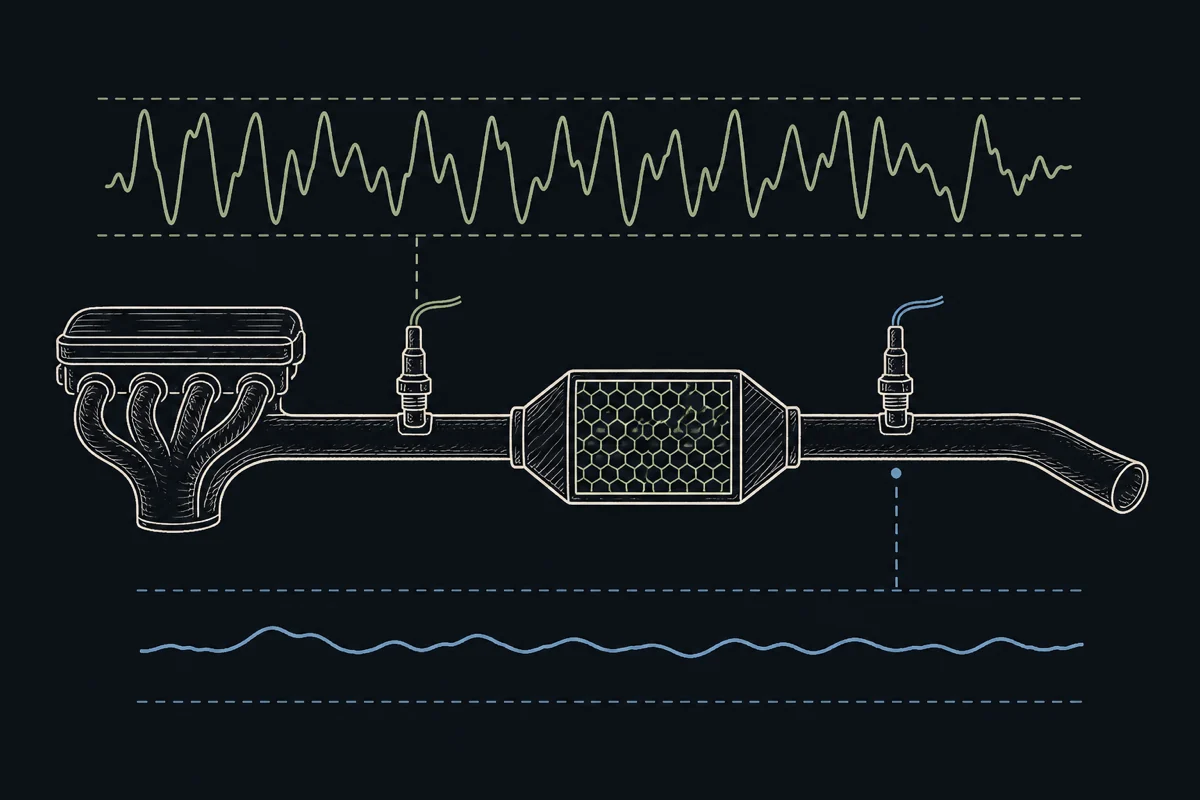
Once the engine and exhaust reach the required conditions, the computer compares the front oxygen sensor'sA sensor that reports oxygen in the exhaust. The front sensor helps the computer control the mixture; the rear sensor helps it judge what changed across the converter. Expected signals depend on the engine and test conditions.Sources: [10] signal with the rear oxygen sensor's signal. [10]
Exhaust flows from the engine past the front oxygen sensor, through the converter, past the rear oxygen sensor, then through the muffler and tailpipe. The monitor reads the two sensor signals; it does not inspect the converter directly. [10]
A working converter stores oxygen and smooths the changes in the exhaust. If the rear signal follows the front signal too closely, the computer can determine that catalyst efficiency is below the monitor's limit and store P0420. [10]
Bank 1In OBD terminology, a bank is one group of cylinders. Bank 1 contains cylinder 1. An inline-four has one bank; a V6 or V8 has two, and the physical side depends on the exact engine.Sources: [24] [1] is the cylinder bank that contains the engine's first cylinder. P0430 is the matching catalyst-efficiency code for the opposite bank. [24][1]
An inline-four Toyota has only one cylinder bank, so there is no side to choose. A V6 or V8 has two banks, and the physical side of Bank 1 depends on the engine.
Confirm the engine family and cylinder layout in Toyota service information before ordering a sensor or converter. [24]
Before spending
What to check before buying parts
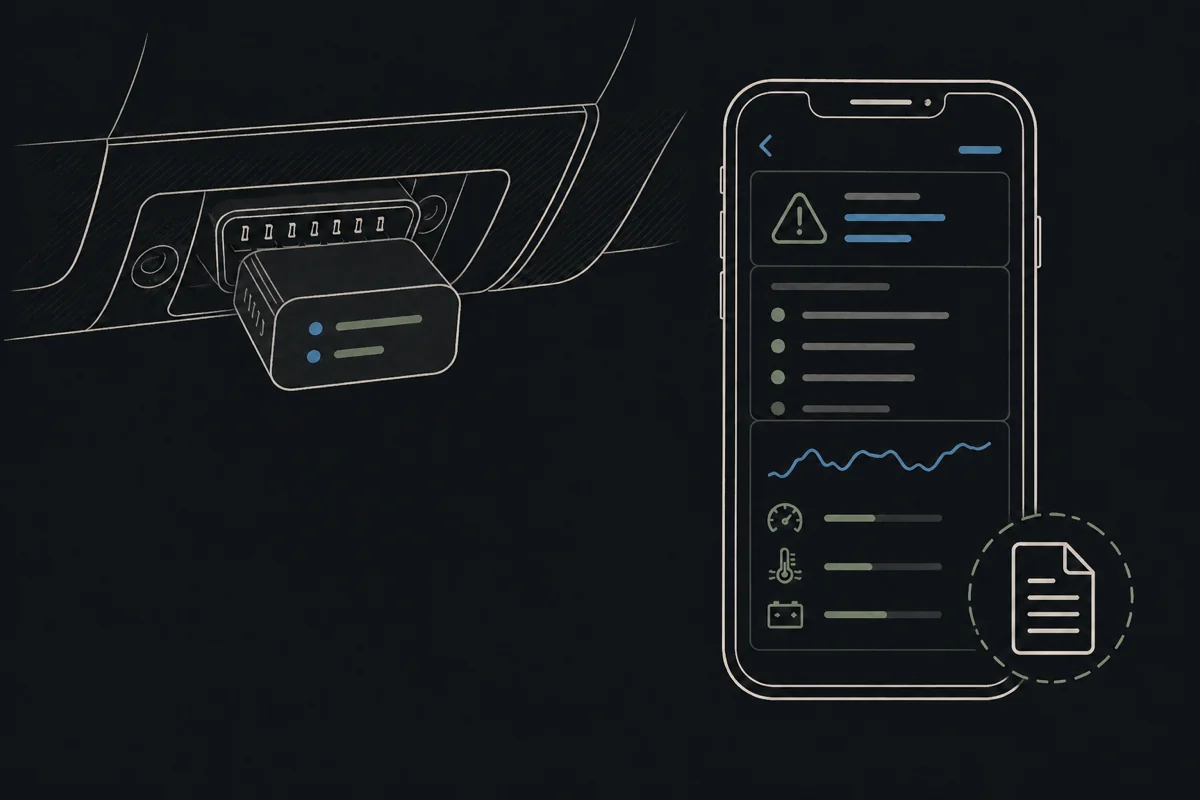
Save the complete scan
Before clearing anything, save current, pending, and permanent codes and the freeze frameThe snapshot the vehicle stores when it records the fault. It helps a technician reproduce the conditions present at that moment.Sources: [10] — the fault snapshot. Also save the readiness status.The completion state of the vehicle's emissions self-tests. After codes are cleared, a monitor can be incomplete even when the warning light is off.Sources: [14] It tells you whether the emissions self-tests have run to completion.
Write down what changed
Note the light, rough running, power, fuel use, oil use, exhaust smell, and exhaust sound.
Record the vehicle details
Write down the year, model, engine, mileage, and VIN.The vehicle identification number: the unique 17-character identifier used with build data to match the exact vehicle to bulletins, recalls, and warranty coverage. A VIN match does not by itself diagnose the fault.Sources: [4] Keep the emissions label and in-service date with the record.
Keep the repair history
Gather invoices and part numbers for each converter, sensor, exhaust repair, or engine-computer update.
Safe visual and sound check
Visible exhaust damage or an obvious rattle can be checked with the car parked and cool. Stay beside the vehicle; never get underneath a car supported only by a jack.
Read the whole code list first
Misfire, mixture, and sensor-circuit codes can explain the failed catalyst test and can also damage a replacement. Diagnose them before judging the converter.
If P0430 is also present, keep it in the record: it is the Bank 2In OBD terminology, a bank is one group of cylinders. Bank 1 contains cylinder 1. An inline-four has one bank; a V6 or V8 has two, and the physical side depends on the exact engine.Sources: [24] [1] catalyst code, not a duplicate of P0420. Diagnose each bank separately instead of assuming one sensor explains both codes. [24]
Let the finding choose the repair
Do not choose a part from P0420 alone. If a companion code, sensor or wiring fault, or exhaust leak is confirmed, repair that problem first and run the monitor again.
If Toyota has a bulletin for your exact VIN, follow its specified path; a converter becomes a repair option only when the vehicle-specific diagnosis supports it. [10][4]
Popular shortcuts: what they can and cannot tell you
These are common things people try or suggest online because they can change a reading or make the light disappear. That can be a clue; it does not tell you why your Toyota stored P0420.
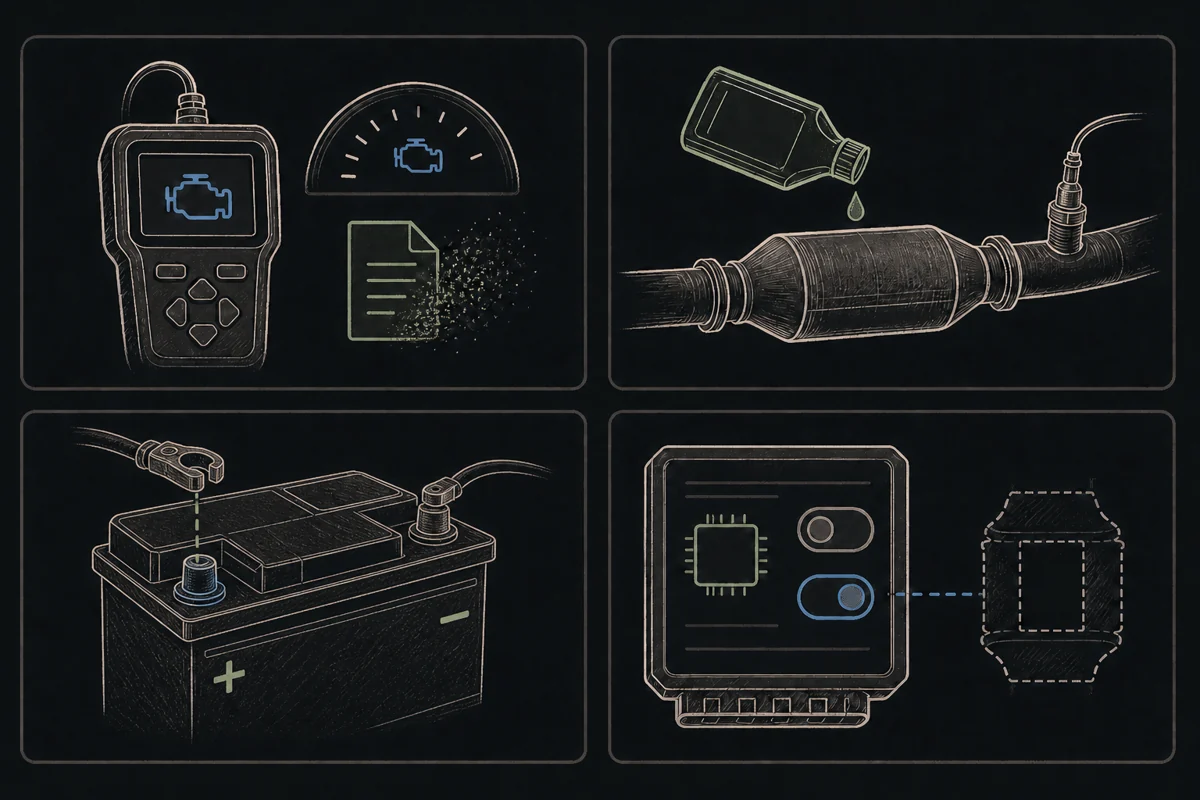
Catalytic-converter cleaner:A bottled fuel additive marketed to remove deposits or help a marginal catalytic converter pass its monitor. It cannot rebuild broken catalyst material, seal an exhaust leak, correct the wrong converter, or repair an engine fault.Sources: [15] [10] a temporary result does not identify the failed part
People try a cleaner hoping deposits are affecting a borderline monitor result.
If the light goes out afterward, that shows only that the monitor result changed; it does not separate deposits, different driving conditions, an exhaust leak, or a worn converter.
Before you decide it helped: Save the complete scan first. Then check companion codes, oil use, and exhaust leaks. Wait for the catalyst monitor to complete before deciding whether P0420 returned. [15]
Rear oxygen-sensor spacer:A small adapter that moves the rear oxygen sensor away from the direct exhaust stream so the sensor reports a different signal. It can mask what the monitor sees; it does not restore the converter or fix the cause.Sources: [13] a changed signal is not a repair
A spacer — or a modified, deeper sensor bung — moves the rear sensor away from the direct exhaust stream. That changes the signal seen by the computer; it does not restore the converter or explain why P0420 set.
Ask for this test: Compare the real signals before and after the converter and check for leaks or sensor faults. This report gives no spacer or bung procedure: altering the rear-sensor signal to hide the code may violate federal anti-tampering rules. [13]
A scan numberA voltage, fuel-trim, or mileage number copied from another vehicle. P0420 diagnosis depends on the exact engine, sensor system, and test conditions, so use Toyota's procedure and your vehicle's scan data — not a universal pass/fail number.Sources: [10] is evidence, not a verdict
One Toyota owner's freeze-frame screenshot records one car at one moment. It is useful evidence for that vehicle, but its readings are not a normal range for every Toyota.
Live-data numbers, including fuel trim,The computer's short- and long-term adjustments to the commanded fuel mixture. The numbers can reveal a mixture problem, but their meaning depends on operating conditions and the exact engine.Sources: [10] make sense only with the exact engine, sensor system, and test conditions.
What to collect instead: Keep the full code list and freeze frame. Have the shop compare the upstream and downstream sensor signals, check for exhaust leaks, and use the Toyota procedure for the exact vehicle. [19][10]
A repair storyReplacing a converter because another repair sounds similar. A repair story does not establish the cause on your Toyota; check the vehicle, part specification, exhaust path, and upstream engine condition first.Sources: [10] is not a parts list
A story about a converter replacement can explain what one owner experienced. It cannot show the whole diagnosis or make the same part correct for your Toyota.
Before buying a part: Confirm fit, emissions specification, exhaust leaks, sensor data, and upstream engine condition. Use the exact service procedure; work under a car needs proper support. [10]
Differential
How to separate the likely causes
There is no reliable model-wide failure rate that identifies the bad part on an individual Toyota. Use evidence from your own car to separate a sensor problem, a converter problem, and faults elsewhere in the monitored system.
Federal complaints show what the expensive end of this problem can look like: owners described converters that failed or were replaced.
They do not show how often a converter is the cause, because quick and inexpensive fixes are less likely to become federal complaints. [2]
P0420 alone, steady light, normal power
What it changes
A worn converter is possible, but the code still does not identify the part.Useful next evidence
Ask the shop to show the leak-check result, the sensor signals before and after the converter, and the catalyst monitor's on-board component-test results (often labeled Mode 6On-board test results for emissions monitors and their components. Labels and limits depend on the vehicle and scan tool.Sources: [10] on a scan tool).Those results help show whether the monitor sees the two sensor signals as too similar. [10]
Misfire, rich or lean mixture, oil use, or sensor-circuit codes
Rattle or clear power loss
The exact vehicle matches a Toyota bulletin
What it changes
The factory path may include more than one operation.Useful next evidence
Have Toyota match the VIN, engine, transmission, emissions label, build date range, and engine-computer software history. [4]
Toyota factory guidance
Is there a factory repair path for your Toyota?
A Toyota service bulletinA manufacturer document for service technicians that describes a known condition, the vehicles it may affect, diagnostic checks, and a repair path. It is not a recall and does not automatically promise a free repair; applicability and coverage must be checked for the exact VIN.Sources: [4] [3] (TSB) is a dealer repair document about a known pattern: which vehicles are covered, what to check, and what repair may apply. It is not a recall and does not promise a free repair.
Start with the bulletin number and its vehicle coverage — model year, engine, transmission, emissions label, and production range. Toyota confirms the final match by VIN.
For a RAV4, 4Runner, Tundra, or any other Toyota, do not transfer a repair from another configuration: match the exact vehicle to the record first. [4]
Corolla, Matrix, and Camry: engine computer + converter
For listed Corolla, Matrix, and Camry configurations, Toyota's path can include converter work plus an engine-computer (ECM) update. The exact computer and transmission can change the required repair steps.
Before paying: Ask the dealer to match the bulletin to your VIN and vehicle build. These bulletins originally described emissions-warranty repairs.
EG028-04Corolla 2003–2004 (1ZZ-FE)
Corolla (1ZZ-FE): a new-design converter plus an ECM update when the listed computer is reprogrammable. Exception: the listed 2003 automatic-transmission configuration with a Delco ECM requires ECM replacement instead of reprogramming. Covered in its day under the 96 months / 80,000 miles emissions warranty. [4][28]
EG024R-04Camry 2002–2004 (2AZ-FE, non-PZEV, automatic)
Camry (2AZ-FE, not certified as a partial-zero-emissions vehicle (PZEV)): an applicable automatic within the production range gets updated computer logic plus a new-design converter; the manual-transmission path is converter replacement only. Match the transmission and VIN before using the bulletin. [4][28]
Physical converter damage
Toyota documented catalyst rattle or deteriorated catalyst material on specific vehicles.
T-SB-0161-13Tacoma 2010 (2TR-FE)
Catalyst rattle on the 2010 Tacoma — the bulletin's procedure directs a technician to localize the noise to the catalyst section of the front exhaust pipe before replacing that assembly. [16]
T-TT-0698-22Highlander 2017–2022 · Sienna 2017–2020Expired · historical clue
The archived Tech Tip flags possible deteriorated catalyst material on 2017–2022 Highlander and 2017–2020 Sienna. [17]
Status: The Highlander/Sienna Tech Tip expired June 20, 2023. Use it as historical evidence, not current repair authorization.
If your Toyota is not listed above
The factory documents above apply only to specific Toyota configurations in our source set. Not seeing your model here does not mean Toyota has no information.
It means this report did not find an exact P0420 document for that configuration. Ask Toyota to search current documents by VIN; if none applies, use the general evidence-first diagnosis.
Some documented P0420 paths are configuration-specific and may include calibration work or a different repair. Only a document that matches your VIN tells you which. [4]
If Toyota finds a matching bulletin, ask separately about recalls and warranty coverage. A bulletin guides service work; it is not a recall and does not by itself promise a free repair. [3]
Other Toyota models people search with P0420
These Toyota model names appear in P0420 searches. A model name alone does not create a factory repair path. Use the general diagnosis unless Toyota finds a document for the exact vehicle:
- Avalon
- Tundra
- Toyota RAV4 / Toyota RAV 4
- 4Runner
- Sequoia
- Celica
- Yaris
- Echo
- Solara
- Toyota FJ Cruiser
If no matching factory record appears, use the general evidence-first path rather than applying a listed bulletin.
What the public record shows
Why P0420 can return after a repair
We reviewed public Toyota discussions to understand what happens after a repair, not to crown a winning part. The two checked cases below each identify the vehicle, P0420, the work already done, and what happened next. [18][25][31]
Two Toyota owner reports describe P0420 returning after work or remaining after several parts were tried. They show a common pattern: a repair can silence the light without proving why P0420 set.
In a 2007 Camry owner report, gasket work and an oxygen sensor were followed by about a month without the code, then P0420 returned.
In a 2005 Corolla report, a converter, both oxygen sensors, and a cleaner had already been tried and P0420 was still on. A separate 2008 Prius owner account recorded repeated resets and only a short follow-up after replacement.
These are owner reports, not a verified long-term diagnosis: a short quiet period — or an expensive sequence of parts — does not identify the cause. [25][31][30]
Use a case as a question list, not a shopping list.
If the light returns or stays on after work, keep the current code list and freeze frame, then have the exhaust path, sensor signals, and upstream engine condition checked before pricing another part. [25][31][10]
Two repair stories, and the question each leaves open
These are checked individual-vehicle records, not repair recipes. Read each as a short case report: what changed, what happened next, and what still needed to be tested.
A Camry went quiet after sensor and gasket work — then P0420 returned
A 2007 Camry had gasket work and an oxygen sensor replaced. The code went away for about a month, then P0420 returned.
A month without the light showed only that the monitor had not failed immediately; it did not identify the failed part. Recheck the current scan, wiring, leaks, and sensor behavior before buying another part. [25]
A Corolla still had P0420 after a converter, sensors, and cleaner
In one 2005 Corolla owner report, the catalytic converter, both oxygen sensors, and a catalytic cleaner had already been tried. The check-engine light was still on with P0420.
That sequence does not prove any one part was wrong or that every other Toyota needs the same work. Start again with the current codes, freeze frame, exhaust leaks, and upstream engine condition before approving the next part. [31]
Diagnosis
How a shop confirms the cause
A useful diagnosis leaves a short written trail:
- Code list and freeze frame: The write-up should list every current and pending code with the original fault snapshot, or freeze frame, not P0420 alone.
- Exhaust-path result: The monitored path must be identified, along with any leak, damage, or loose catalyst material found during the check.
- Sensor evidence: Actual signal, heater, wiring, and response evidence should support any decision to implicate or clear a sensor.
- Upstream-engine findings: The findings should say whether misfire, fuel control, coolant entry, and oil use were ruled in or ruled out.
- Exact Toyota match: Any bulletin or engine-computer software must match the emissions label, build date range, and VIN.
- Completed repair check: Verification requires a completed catalyst monitor and confirmation that the fault did not return during the check.
Ask the shop these two questions:
- Does my VIN match a Toyota bulletin or emissions-warranty repair?
- What scan, leak-check, and sensor evidence supports the part you recommend?
Money and timing
Cost, warranty, and emissions inspection
No catalyst or emissions recalls on file for these models
We checked NHTSA recall records for all 12 model-year pairs in the complaint set. [3]
Each vehicle carries between 0 and 13 recall campaigns on file — none of them is a catalyst or emissions-system campaign.
Recalls are VIN-specific — check your own VIN directly on nhtsa.gov/recalls · Checked against NHTSA ·
Coverage depends on your exact Toyota
Ask Toyota to check the VIN and emissions warranty before authorizing a converter repair.
US coverage depends on the model year, emissions label, in-service date, and exact warranty booklet.
Federal coverage
The federal emissions Performance Warranty covers emission-control parts for 2 years / 24,000 miles. If the car failed a state emissions test in that window, the manufacturer may be responsible for the repair under warranty. [5]
The longer 8 years / 80,000 miles federal Design & Defect coverage applies to exactly three components: the catalytic converter, the engine computer, and the on-board diagnostic device. Ask Toyota whether the catalytic converter is still within that federal coverage. [5]
California-certified vehicles
The California Air Resources Board (CARB) lists 3 years / 50,000 miles emissions-defect and performance coverage for California-certified vehicles. It also lists 7 years / 70,000 miles for parts identified as high-priced in the vehicle's warranty material. [6]
Check the vehicle's emissions label before applying either California tier. Do not assume every vehicle or catalytic converter qualifies. [6]
Partial Zero Emission Vehicle (PZEV) and Transitional Zero Emission Vehicle (TZEV) models
CARB lists 15 years / 150,000 miles coverage for emissions-related parts on qualifying 2001–2017 Partial Zero Emission Vehicles (PZEV) and 2018–2025 Transitional Zero Emission Vehicles (TZEV). Battery rules are separate. [6]
PZEV or TZEV status is a screening clue, not automatic coverage for a particular repair. [6]
Use cost estimates as planning numbers
Read the replacement estimates only if diagnosis confirms the converter.
They are not a forecast for your car; checking for an exhaust leak, diagnosing sensor or wiring faults, verifying engine-computer software, and finding engine problems that can damage the converter are different jobs. [10]
In the cited RepairPal snapshot, the national converter-replacement estimate is $2,283–$2,473. Its Toyota estimates are $1,875–$1,952 for Camry and $2,117–$2,177 for Corolla. [9]
The RepairPal figures are third-party estimates, not quotes. Use them only to plan a rough range. Prices, labor figures, and service-life claims in older owner threads are historical anecdotes, not current estimates or warranty terms.
When you request a quote, ask for the converter manufacturer, part number, legal emissions specification, and warranty. [9]
Federal complaints show the stakes, not a typical price: owners reported multi-thousand-dollar converter bills. [2]
Plan around the local inspection rule
Inspection rules vary by state and locality. An illuminated malfunction light or stored emissions fault can block a pass in programs that use on-board diagnostics. [14]
One Sienna owner told the federal complaint system that a failed smog check blocked registration renewal until the fault was resolved. That is a documented consequence, not a universal state rule. [2]
Clearing P0420 repairs nothing. ReadinessThe completion state of the vehicle's emissions self-tests. After codes are cleared, a monitor can be incomplete even when the warning light is off.Sources: [14] starts over when codes are cleared, so a light that remains off does not mean the emissions monitors are complete.
Evidence
Evidence and method
Standard and factory records
The standard definition and Toyota factory records define the monitored system and model-specific repair paths.
Federal complaints
NHTSA complaint records include 12 Toyota and Scion owner reports that explicitly name P0420. We use them to show documented consequences; they cannot estimate how often a cause occurs. [2]
Toyota bulletin applicability
The factory paths apply only after engine, transmission, emissions label, build date range, and VIN are checked.
Where the bulletin records come from
Bulletin metadata comes from NHTSA’s registry of factory communications. Source copies used for the repair claims are preserved in our research archive. [4]
Why this is more than a parts lookup
This report keeps model-scoped Toyota records, documented federal complaints, and VIN or warranty decisions separate. A code alone is not a parts fitment decision.
Community and video records
We reviewed 134 public Reddit, Toyota-forum, and YouTube threads as owner evidence, not repair instructions. [18][20][21]
Outcome limits
Of those public records, 130 had enough readable outcome text to determine whether a repair was confirmed; 116 did not name a confirmed final repair. A temporarily unlit warning light did not count as proof. [18][20][21]
Warranty and inspection material
EPA, California, and Toyota material define general coverage tiers. A VIN check and warranty booklet still decide the exact claim.
Accountability
About this report
Cavox Research Team is the editorial and data team behind Cavox, an OBD2 scanner app in development. The team uses factory, federal, regulatory, repair, and owner evidence to explain what a driver should check next.
We do not invent a named mechanic or claim a repair was verified when the source never reported an outcome.